 ES
ES EN
EN ES
ES
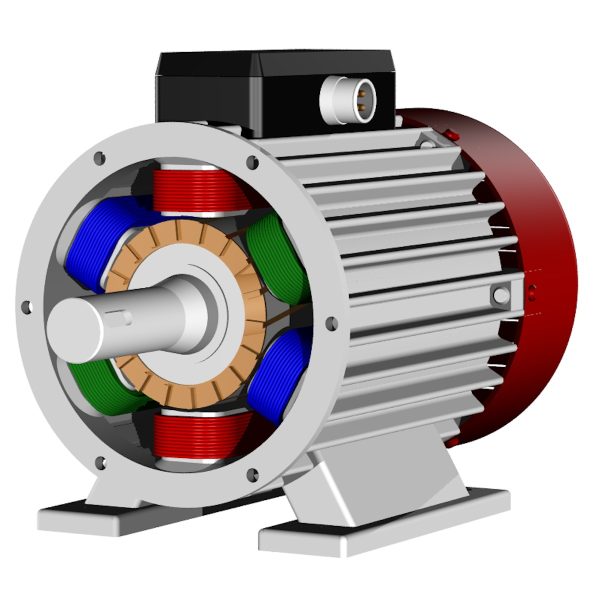
A three-phase induction motor has a wide range of applications in both commercial and industrial sectors. Below, we list some of the most common applications:
- Compressors
- Air conditioning/Heat pumps
- Fans and air conditioners
- Industrial machinery
- Pumping
Given the broad range of applications for induction motors, it is crucial to understand the most common faults that occur and how to protect motors against these faults.
Fault Protection:
Electrical faults occur when there’s an abnormally high current or abnormal voltage. Some common faults include:
- Short circuits
- Ground faults
- Line-to-line faults
- Overload
- Low/high voltage
- Phase failure/imbalances
- Voltage surges
Specifically for motors, a common fault can occur during startup due to a locked rotor. Induction motors can consume 500% to 800% of their rated current during startup. While this high consumption isn’t harmful as it lasts very briefly, an extended period can damage the motor if it fails to start.
To protect against these electrical faults, it’s necessary to use protective relays. There are many types, from well-known thermal-magnetic relays (used to protect against short circuits) to more sophisticated electronic protections that monitor power, three-phase currents, and/or three-phase voltages.
If a fault occurs and is not interrupted, it can cause fires or irreparable damage to the electric motor components. These protective relays disconnect the motors when they detect a fault that could cause damage.
Overload Protection:
An overload occurs when motor currents (or power) exceed nominal values. Unlike a short circuit, an overload can happen by just slightly exceeding the rated current by a few amperes. However, overloads can cause irreversible damage due to the heat buildup generated.
Protection against overloads can be achieved through thermal or electronic relays:
- Thermal protection typically relies on the expansion and contraction of calibrated metallic contacts to interrupt the circuit when the nominal current is exceeded.
- Electronic protection measures current and/or power to disconnect the motor when nominal values are exceeded. These protections are more effective than thermal protection, offering greater flexibility and protection across different applications and motors.
Unlike other electrical faults, overload protection has a disconnection delay. The purpose of this delay is to allow momentary, non-damaging overloads that occur during the operation of some applications. Electronic overload protections have great flexibility in managing these disconnection delays, ensuring the proper functioning of motors in applications with load variations.
Protection against High/Low Voltage:
Electric motors are designed to operate within a certain voltage range. Any voltage variation outside this range will cause problems that can shorten the motor’s life:
- Low voltage causes the motor to have higher current consumption to handle the same load. Over time, this damages the motor and increases starting currents.
- High voltage results in saturation of the motor’s ferromagnetic core, which also increases three-phase line currents.
It’s essential to equip motors with protective relays that immediately disconnect the equipment if the voltage is outside the range for which it was designed to operate.
Protection against Phase Failure/Imbalance:
A three-phase motor can continue to operate even if it loses one of its phases. However, this increases the current in the remaining two phases and causes considerable mechanical stress.
This condition damages the motor unless it is quickly disconnected. Voltage imbalance is a condition similar to phase failure in which one or more phases have different voltages.
Voltage imbalance increases current consumption, relative power loss, and accumulated heating within the motor, leading to premature failure. Typically, voltage imbalance should not exceed 2% to ensure optimal motor operation.
A 5% imbalance is enough to damage the motor and result in a 25% relative power loss. Detecting any imbalance or phase loss immediately is crucial.
Phase failure and imbalance relays are used to prevent these types of faults and disconnect the equipment before damage occurs.
If you are interested in protecting your equipment, you can view our phase failure, imbalance, and high/low voltage protection relays. Click here for more information.
One response to “What are the most common failures in three-phase motors and how to protect against them”
This is excellent, I’ll like to know more